We Read 13,332 Job Postings: What Employers Actually Ask For (2026 Study)
A count of resume keywords in 13,332 real job postings from 89 companies: which tools show up, how long they say experience should be, and which buzzwords barely appear.
Published by MatchCV. Editorial scope and corrections.
Most resume keyword advice is a list somebody wrote from memory. Python, stakeholder management, Jira, "results-driven." We wanted to know how much of that list survives contact with real job postings, so we pulled the postings and counted.
This post is the count. It covers 13,332 distinct postings from 89 companies, collected on 14 October 2026. Five findings changed how we'd advise someone to edit a resume, and the last section lists what the data can't tell you.
What we counted
We collected every open posting from the public job-board feeds that Greenhouse, Lever and Ashby provide for their customers. Those feeds are meant to be read by anyone, and we kept only aggregate counts, not the postings themselves.
| Distinct postings | 13,332 (14,180 collected; the same text posted for several locations counts once) |
| Companies | 89 |
| Platforms | Greenhouse 10,030 · Ashby 2,559 · Lever 743 |
| Median length | 928 words |
| Postings sorted into a role | 5,126, by job title |
We looked in depth at five roles where the sample was large and the titles were unambiguous: software engineer, product manager, sales rep (SDR and account executive), security engineer and program manager. Customer support (55 postings), graphic design (24) and data analyst (109) were too small or too messy to quote, so we don't.
Three corrections we made along the way, because each would have changed the result:
- Company boilerplate. About 24% of the lines in these postings are paste-in "About us," values and benefits text. We removed any long line that appears verbatim across several of a company's postings in different roles. Without this, a sales posting that says "we are the Data and AI company" counted as asking for AI.
- Heavy hirers. A few companies post hundreds of openings. Every percentage below uses at most 20 postings per company and role (postings we couldn't sort into a role count as one group), so no single employer sets the number. Most figures moved by less than three points with or without this cap.
- Our own term lists. A term only counts if our matching rule finds it, and we hand-read samples of matches to fix rules that were too loose. Where a number depends on that, we say so.
Finding 1: Postings name a working vocabulary, not a tool list
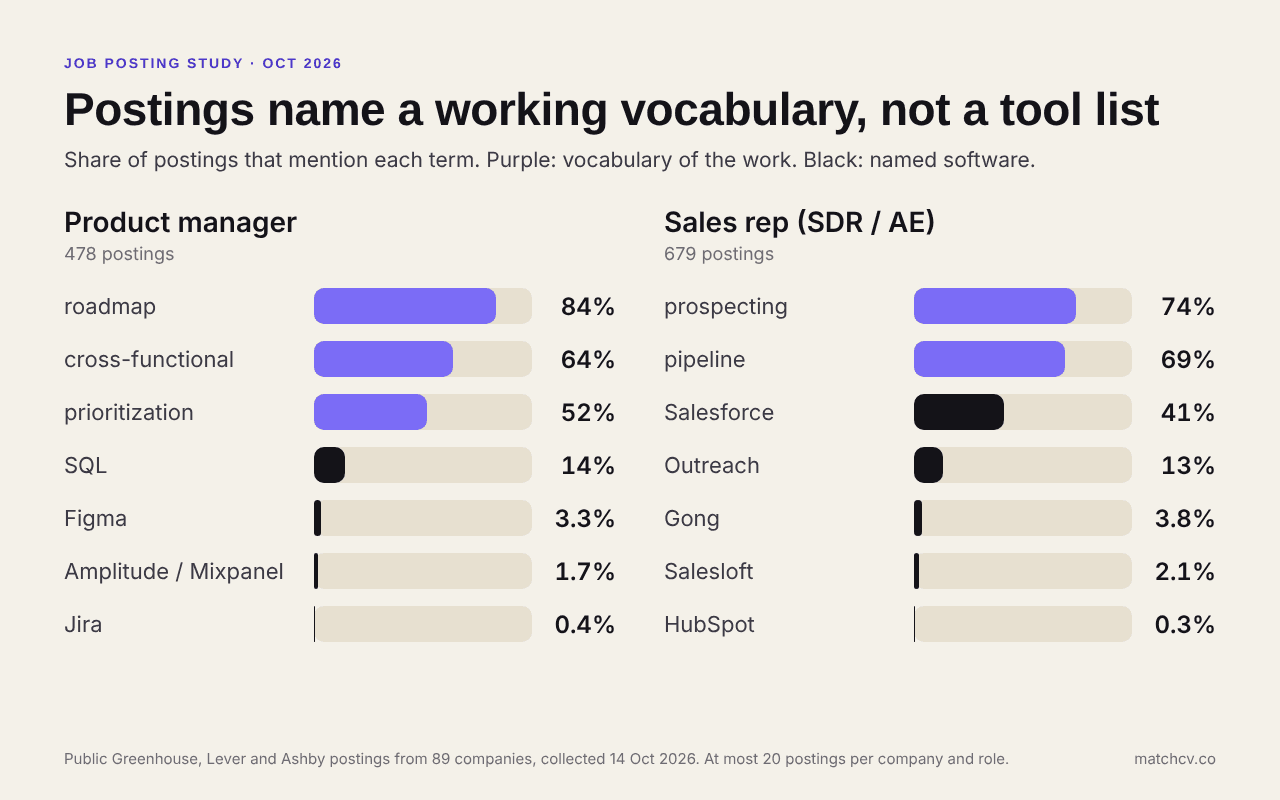
In 478 product manager postings, "roadmap" appears in 84%, "cross-functional" in 64% and "prioritization" in 52%. The tools a PM resume usually lists barely register: Figma 3.3%, Amplitude or Mixpanel 1.7%, Jira 0.4%. SQL is the one named skill that shows up with any weight, at 14%.
Sales looks the same. Across 679 postings, prospecting appears in 74% and pipeline in 69%. Salesforce is the one named tool that matters (41%). Outreach is at 13%, Gong at 3.8%, Salesloft at 2.1% and HubSpot at 0.3%.
This doesn't mean those tools are worthless. HubSpot is common among smaller companies, and these boards skew toward larger tech employers. What it does mean is that a skills line copied from a "top 20 skills" article is mostly noise against any one posting. List a tool when the posting names it and you've used it. Put your space into the vocabulary of the work itself, written as things you did.
Finding 2: One stack list doesn't cover the postings
For software engineers we tracked 49 languages, frameworks, platforms and practices. The median posting names five of them. The most common ones:
| Term | Share of software engineer postings |
|---|---|
| Python | 39% |
| Distributed systems | 39% |
| Go | 32% |
| AWS | 29% |
| Java | 26% |
| Kubernetes | 26% |
| React | 24% |
| TypeScript | 23% |
| LLMs | 19% |
| Machine learning | 17% |
Suppose you built the ideal generic resume that contains the 15 most common terms. Only 20% of postings would be fully covered by it. The other 80% name at least one tracked term you left out.
That's the strongest evidence we found for tailoring. The common terms really are common, and a generic list still misses most postings. Security engineer postings show the same thing: a list of the top 15 terms fully covers 41% of them.
One caution about the ranking itself. Go beats Java here, and it won't in every market. These boards are heavy on infrastructure, cloud and developer-tools companies, so treat the order as a picture of that slice of hiring.
Finding 3: Most postings state a number of years, and the levels don't line up neatly
Between 64% and 75% of postings in the five roles state a years-of-experience figure. Taking the first one stated, the median for software engineer postings was:
| Level in the job title | Postings | Mention years | Median years |
|---|---|---|---|
| Entry / intern | 35 | 11% | 2 |
| Mid (no level in title) | 369 | 58% | 3 |
| Senior | 386 | 69% | 5 |
| Staff, principal and up | 347 | 71% | 8 |
Product managers read differently. Mid-level and senior postings both have a median of 5 years, and staff-level has 8. Titles don't map onto experience the way a resume summary suggests, which is a reason to copy the posting's own number into your summary line when it's true, rather than guess what "senior" means.
Degrees matter less than the folklore says. A degree is mentioned in 27% of software engineer postings, 23% of product manager postings, 25% of sales postings and 21% of security engineer postings. In 10% to 23% of postings across the five roles, the posting says "or equivalent experience."
Finding 4: The classic buzzwords barely appear
Resume guides love "team player," "self-starter" and "detail-oriented." Here is how often they appear, next to the soft-skill words postings actually use.
| Share of postings | Software engineer | Product manager | Sales rep | Security engineer | Program manager |
|---|---|---|---|---|---|
| "team player" | 1.1% | 0.2% | 8.7% | 0% | 2.5% |
| "self-starter" | 2.2% | 1.3% | 7.4% | 0.5% | 2.0% |
| "detail-oriented" | 3.2% | 5.6% | 2.7% | 1.5% | 7.8% |
| "communication" | 52% | 70% | 63% | 65% | 84% |
| "cross-functional" | 33% | 64% | 35% | 31% | 80% |
| "ownership" | 36% | 32% | 18% | 25% | 29% |
| "leadership" | 22% | 45% | 20% | 26% | 66% |
The words that dominate are communication, cross-functional work and ownership, and each is easier to show than to claim. "Led a cross-functional launch with design, legal and two engineering teams" does more for a program manager resume than a skills list containing "cross-functional collaboration," because the bullet is the evidence the skills list only asserts.
Finding 5: At least a third of postings separate must-haves from nice-to-haves
We looked for standard headings. "Preferred qualifications," "nice to have," "bonus points" and "even better if you have" count as a nice-to-have section. "Requirements," "minimum qualifications" and "what you bring" count as a must-have section.
- At least 34% of postings have a nice-to-have heading.
- At least 50% have a must-have heading.
- At least 20% have both.
These are lower bounds. We matched whole-line headings strictly, because looser matching picked up pay lines like "bonus and equity" and inflated the number. Postings that phrase their sections differently are counted as having none.
The reason it matters is how the two halves get used. In the postings that split them, the long-tail tools tend to sit under the nice-to-have heading. Treat those as secondary. Our own match score weighs required terms at 80% and bonus terms at 20% for this reason, and you can apply the same priority by hand.
What this study can't tell you
- The sample is tech-heavy. Greenhouse, Lever and Ashby are used mostly by tech companies and scale-ups. Nursing, accounting, trades and public-sector hiring are not represented, and we won't claim they look the same.
- A posting is not an ATS filter. We counted what employers wrote. We did not observe what any applicant tracking system or recruiter searched for. Appearing often in postings is a reason to include a term, not proof that it's filtered on.
- Mention is not importance. A term in the first requirement and a term in a long closing list count the same here.
- Roles were assigned by title. We read samples of titles in each role and tightened the rules until the samples looked right. Some postings are still misfiled.
- One snapshot. Everything is from 14 October 2026.
How to use this on your own resume
1. Open your target posting and mark each term as must-have or nice-to-have. Spend your keyword effort on the must-haves.
2. For every tool the posting names, check that you've used it before listing it. For tools it doesn't name, ask whether listing them earns the space.
3. Match the years and level wording in your summary to the posting when it's true of you.
4. Replace buzzwords in your skills section with one bullet that shows the behavior, using words the posting uses.
Paste your resume and a posting into the resume keyword scanner to see which of the posting's terms your resume already covers. If you're still working out which posting terms matter, the guide to finding resume keywords in a job description walks through it by hand.
Find the keywords your resume is missing for any job description
Scan my resume keywords →or sign in free to tailor your resume with AI